
Extreme for Extreme
“Men will be men.”
You hear it whenever a husband beats his wife, as though violence is a language men are born speaking, and women must learn to endure it. As though their harm is inevitable. I don’t accept that, not even a little.
I have been married for over a decade, and in all that time, I have never imagined beating my wife. Not in anger, not in frustration, not even in passing. Likewise, I have never cheated on her, which, if we are honest, is also a form of intimate partner violence. Yes, cheating is a form of intimate partner violence. Betrayal wounds. It destabilises people and violates trust in ways that linger long after the act. So when I hear that violence is just “what happens” in relationships, I question it deeply.
Growing up, I formed a simple standard that the person you claim to love is not your opponent. They’re not your outlet nor your battlefield. No! Not at all. I hold that no degree of provocation should justify the cannibalism of fighting or beating one’s partner. None.
No degree of provocation should justify the cannibalism of fighting or beating one’s partner.
constant ngozi Tweet
Let’s call things what they are. Beating your wife is not “discipline.” It is not “anger issues,” and it is not “a mistake.” It is raw, dehumanising violence. And it does not begin with the first slap. It begins with entitlement. With the belief that you can dominate another human being because you can, and because they are bound to you by love, marriage, or circumstance.
And it doesn’t stop at marriage. Unmarried relationships carry the same sickness. A boyfriend who beats, controls, intimidates, or coerces is no different in spirit from a husband who does the same. The absence of a ring does not reduce the harm.
People often ask what should be done about men who go that far and raise their hands to violate the very person they vowed (or claimed) to protect. My position is not mild.
Any man who beats his wife should face the extreme consequence of losing the very hand he used. Extreme for extreme, because raising a hand and violating a woman is extreme, so extreme that any man who does that should be amputated. How about that? Crossing the red line, meaning losing the hand.
Raising a hand and violating a woman is extreme, so extreme that any man who does that should be amputated.
Constant ngozi Tweet
That stance unsettles people whenever I take it… Good. It should. We have normalised the wrong things for too long. We have softened our language around brutality and hardened our tolerance for it.
Violence in intimate relationships is not an accident. It is a decision repeated over time, sometimes escalated, sometimes disguised, yet always rooted in a willingness to harm.
Marriage has taught me many things, but one stands out above the rest: love is restraint as much as it is expression. It is choosing, again and again, not to cross certain lines, even when you are angry, tired, misunderstood, or hurt. Especially then.
Choose someone who will see cheating on you as divorcing you.
constant ngozi Tweet
Cheating is a form of intimate partner violence.
Constant Ngozi Tweet
To those choosing partners, hear this and hold it close:
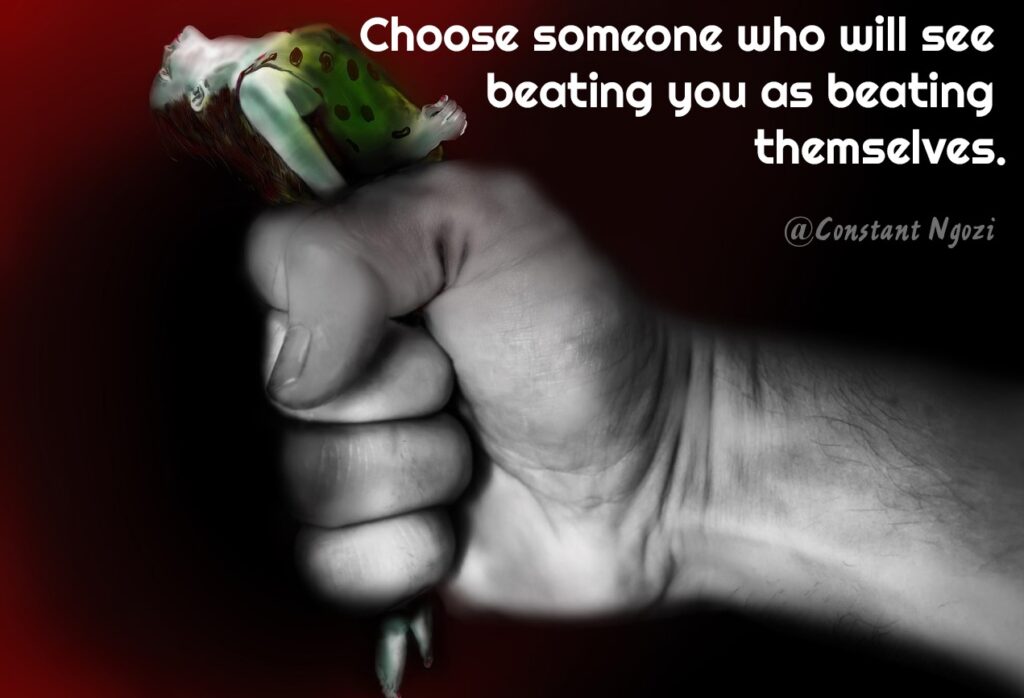
- Choose someone who would see beating you as beating themselves.
- Choose someone who will see cheating on you as divorcing you.
- Choose someone who will see being faithful to you as being faithful to themselves.
- Choose someone who values honesty with you as with themselves.
Anything less is a gamble with your dignity, safety, peace, growth, and life.
And to the men who still think violence proves strength, there is nothing strong about losing control over your own hands. There is nothing manly about turning your home into a place of fear. The real discipline, the real power, lies in the mastery of self.
Not all men are violent. Not all men cheat. But the ones who do must no longer be excused, explained away, or quietly endured.
Because love does not raise a hand to violate. But where it does, something has gone terribly and unforgivably wrong.
- By Constant Ngozi Ozurumba, Founder, ManAnew Life Empowerment Foundation